
What to know
What you need
A screwdriver, a torch, and a phone for photographs. Most register covers lift out with two screws, and the ones that do not usually unclip. Nothing here needs tools you do not already own.
Take a photo of each thing you look at. It gives you a record, and it makes the conversation far more useful if you do decide to call somebody.
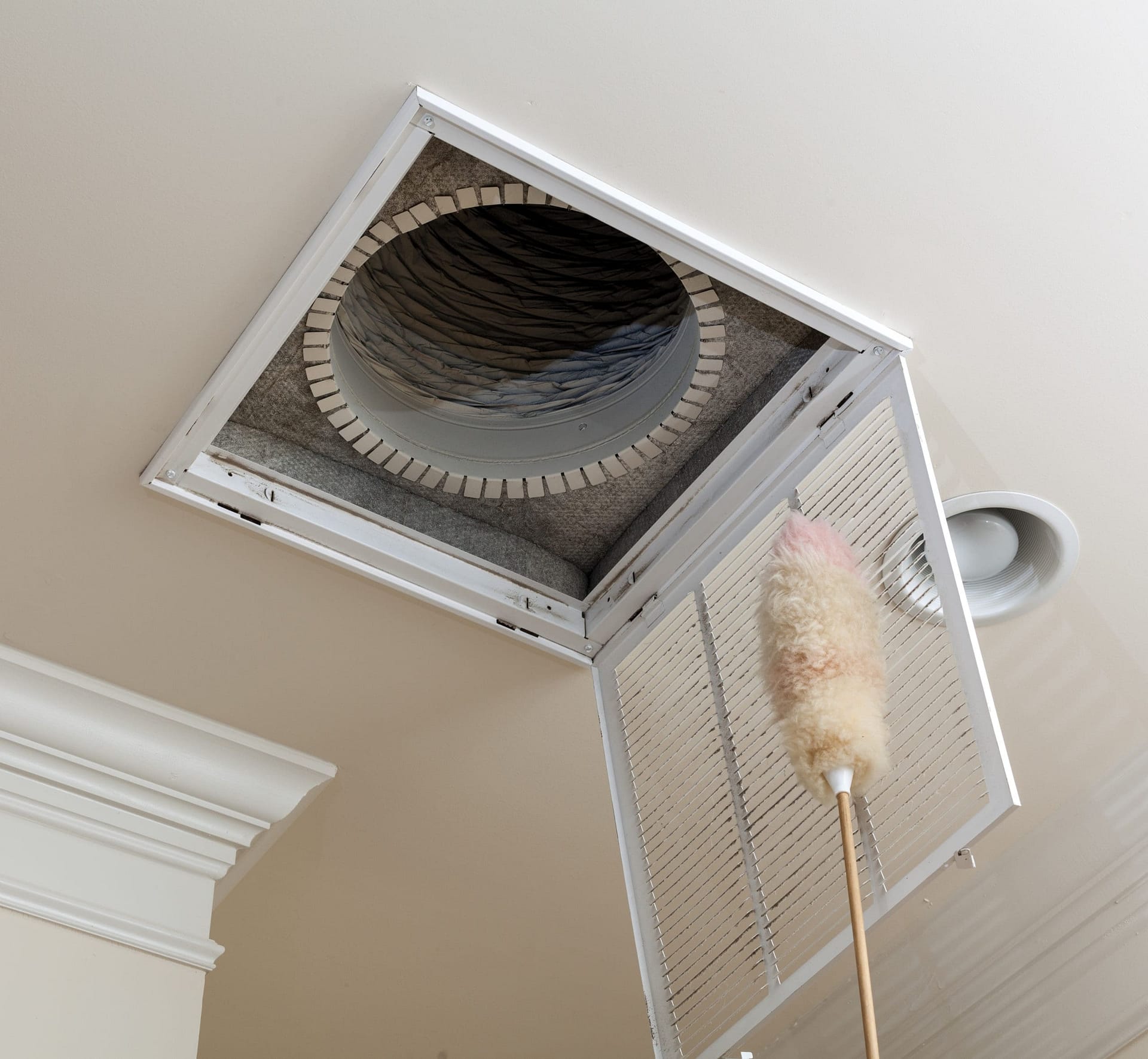
Start with the register covers
- Lift one out and look at the back of it, which usually shows more than the front.
- Run a finger along the inside edge of the opening. A film of dust is normal; a mat you can lift off is not.
- Shine the torch as far down the boot as you can see and look for the point where the duct changes from clean metal to coated.
- Do the same on a return grille, which fills faster than any supply.
Register covers themselves are worth washing in the sink while you have them out. It will not clean the duct, but it stops what has collected there being pulled straight back in.
Then look at the filter
Pull it out and look at it against a new filter of the same type. Even discolouration and visible loading across the pleats is the signal. Holding it up to a light is not the test people think it is: a dense pleated or high-MERV filter blocks light when new, so it condemns filters that are fine. Check the date you wrote on it, and if you did not write one, start.
How fast a filter loads is one of the most useful signals you have. A filter that is grey in a month in a house with no pets and no recent work is telling you something is getting into the system that should not be.
Compare, do not judge in isolation
A single dusty register tells you very little. The useful comparison is between places: a bedroom supply against the main return, or a register close to the furnace against the one furthest away.
Big differences are the interesting part. Even accumulation across the house is normal ageing; one run far worse than the rest usually points at something specific, like a duct that was opened during work and never properly closed.
What normal looks like
- A thin, even film of dust on the inside of the opening.
- Register covers that need washing once or twice a year.
- A filter that loads gradually over its rated interval.
- Airflow that feels broadly similar between rooms of similar distance from the furnace.
What is worth a call
- Accumulation you can lift out in pieces rather than wipe away.
- Debris that is clearly construction material rather than household dust.
- A filter loading far faster than it used to with nothing else changed.
- Airflow that has dropped noticeably and stayed down after a filter change.
- Anything in a run that does not belong there, which is more common than people expect.
What to do with what you found
Bring the photographs. A company that is quoting from what you actually have is having a different conversation from one quoting from a price list, and you will be able to tell which is which within a minute.
If what you found is a film of dust and a filter due for changing, the honest answer is to change the filter and check again next year. We would rather tell you that and be the people you call when it does matter.